![[personal profile]](https://www.dreamwidth.org/img/silk/identity/user.png)
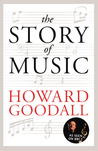 The Story of Music by Howard Goodall
My rating: 5 of 5 stars
Some books need music. Not all of them do, of course: a lot of books are best read in silence, with the mind providing any noise pertinent to the story. But some books require a soundtrack, and depending on the book, the contents of that soundtrack (or, more properly, playlist) will vary: it may contain instrumental works from film, television, or the classical catalogue (both Eastern and Western), or it may be dominated by vocal tracks from artists across the spectrum of popular music, or it might even be a mixture of both. Either way, when a book needs music, one has access to a variety of options for listening to that music, as well as a near-infinite number of artists to choose from. Depending on which corners of the Internet one inhabits, one might even be able to find prebuilt playlists for any book—or any mood—one can conceive of, as well as have the ability to build and share one’s own playlists, all for free.
But the amazing variety and ready availability of any kind of music at nearly any time to almost any listener is a relatively new phenomenon. As late as the early 1900s, it would have been difficult for even the most avid music-lover to even hear their favourite song more than twice or thrice a year, especially if said song was part of a long-format work like a symphony. Music wasn’t a cheap hobby, either: getting into a concert could be expensive. Not until the invention of radio, and then audio recording technology, was it possible for the average person to have ready access to music. This introduction of technology would also be the cause of a split between what is commonly called “classical music” and “popular music”—a split that is in some ways more imagined than real.
( Read more... )